
Ceramic coatings do not fill swirl marks, scratches, or paint defects. Any visible improvement in gloss comes from optical enhancement and surface protection, not from defect correction or leveling. The condition of the paint before application is what ultimately determines the final result.
Ceramic coatings are often misunderstood as a cosmetic fix, but in professional detailing, they are strictly a protection system designed to preserve paint, not repair it.
Established detailing professionals, including experienced installers such as Carolina’s Finest Detailing, consistently emphasize that paint correction, not coating, removes swirl marks and restores surface clarity.
Why This Misconception Exists
The belief that ceramic coatings can “fill” swirls comes from older detailing technologies.
Traditional waxes and glazes contained oils and fillers designed to temporarily mask imperfections. These products worked by altering how light reflected off the surface, creating the appearance of smoother paint without actually correcting defects.
Once those products wore off, the imperfections returned.
Modern ceramic coating systems work very differently. They form a chemically bonded, semi-permanent protective layer that enhances durability and gloss, but does not contain meaningful fillers.
What Ceramic Coatings Actually Do
A ceramic coating in Charlotte is typically based on silicon dioxide (SiO₂) chemistry and bonds to the vehicle’s clear coat at a molecular level.
Its real functions include:
- Chemically bonding with the paint surface
- Increasing resistance to UV damage, oxidation, and environmental contaminants
- Enhancing gloss, depth, and clarity
- Improving hydrophobic water behavior
- Reducing dirt and grime adhesion
These properties make maintenance easier and help preserve the finish, but they do not alter the paint’s physical condition.
Because the coating is extremely thin, it conforms exactly to the surface it is applied to. That means existing swirl marks remain visible after application.
Why Ceramic Coatings Do Not Fill Swirls
Swirl marks are microscopic abrasions in the clear coat caused by improper washing techniques, towel friction, or environmental wear.
For a product to actually fill these defects, it would need:
- Significant thickness to level uneven surfaces
- Soft, flexible fillers that remain stable after curing
- Long-term ability to mask surface irregularities
In Charlotte, NC, ceramic coatings do not meet these conditions. Once cured, they form a hard, transparent layer that mirrors the exact surface underneath.
As a result:
- Swirls remain visible
- Scratches are not leveled
- Defects are preserved under the coating
At best, extremely light micro-marring may appear slightly less noticeable due to increased gloss and reflectivity, but this is an optical illusion, not true filling.
Real-World Professional Detailing Workflow
In professional environments, ceramic coating in Charlotte, NC, is never used as a shortcut for appearance correction. A proper installation follows a structured, correction-first process:
- Paint inspection under controlled lighting
Identifies swirl marks, scratches, and oxidation that are often invisible in normal lighting. - Thorough wash and decontamination
Removes dirt, tar, and embedded contaminants from the surface. - Machine paint correction
The only stage where swirl marks are actually reduced or removed through polishing. - Panel wipe preparation
Removes polishing oils to ensure proper adhesion of the coating. - Ceramic coating application
Seals and protects the corrected finish.
Skipping correction means permanently locking defects under a glossy layer.
Can Ceramic Coating Improve Appearance?
Yes, but only indirectly.
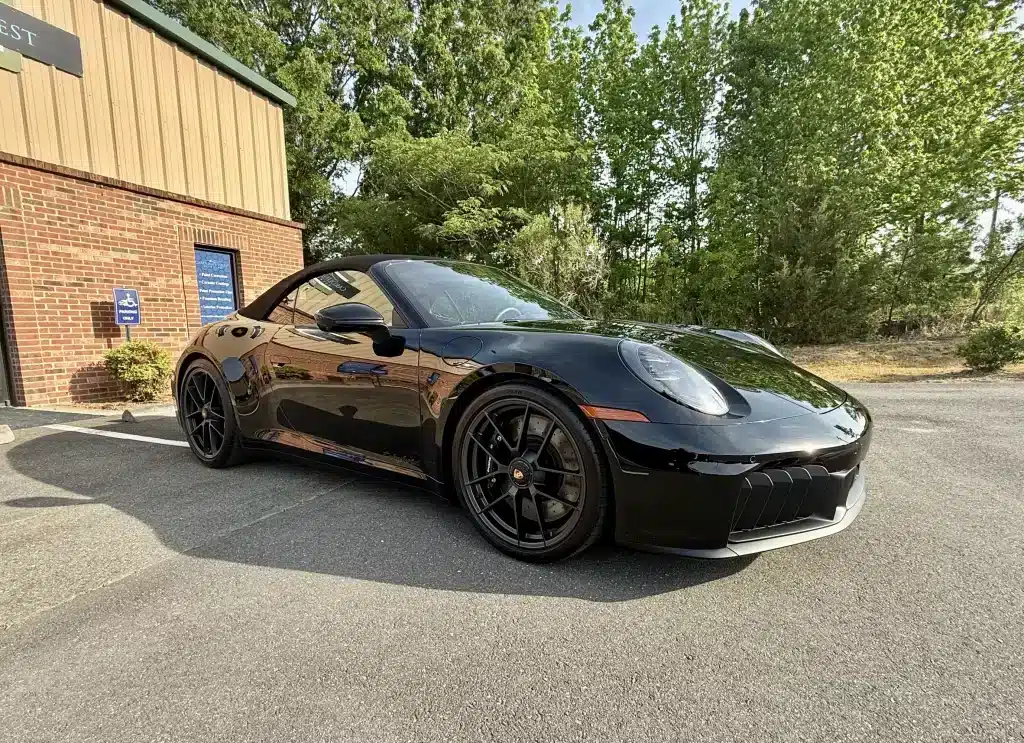
After application, paint often appears:
- Deeper in color
- More reflective
- More uniform in gloss
- Cleaner for longer periods
This is due to improved light reflection and surface uniformity. However, these improvements do not remove or hide swirl marks in any meaningful way.
Defects that were visible before coating will still be visible afterward.
Does Layering Ceramic Coating Help Fill Swirls?
No. Applying additional layers does not significantly increase the ability to mask defects.
- Most coatings are designed for 1–2 layers
- Additional coats do not build meaningful thickness
- Curing chemistry limits how much material can bond properly
- No manufacturer positions coatings as swirl-filling products
Proper paint correction remains the only effective method for defect removal.
Key Takeaways
- Ceramic coatings do not fill or remove swirl marks
- They preserve the paint condition at the time of application
- Paint correction is required for visible defect removal
- Any filling effect is minimal and purely optical
- Surface preparation determines final results
- Coatings protect the finish; they do not improve flawed paint
In Summary
Ceramic coatings are highly effective for protecting automotive paint, improving gloss, and simplifying maintenance, but they are not a substitute for paint correction or a solution for swirl marks.
The best results always come from combining proper surface preparation with professional application. When applied correctly, a coating locks in a refined, corrected finish and preserves it for years.
If you’re considering protecting your vehicle and want a finish that actually looks corrected, not just coated, Carolina’s Finest Detailing recommends starting with a professional evaluation.
Ready for professional ceramic coating and paint correction? Contact us today for a consultation and quote.
Frequently Asked Questions (FAQ)
1. Do ceramic coatings hide swirl marks?
No. Ceramic coatings do not hide swirl marks. They may slightly increase gloss, but the defects remain visible unless polished out beforehand.
2. Can ceramic coating fix scratched paint?
No. Ceramic coatings do not repair or remove scratches. Only machine polishing (paint correction) can reduce or eliminate them.
3. Will polishing eliminate the need for ceramic coating?
No. Polishing corrects defects, but it does not protect the surface long-term. Ceramic coating preserves the corrected finish and helps maintain it.
4. Does applying more layers of ceramic coating fill imperfections?
No. Additional layers do not provide meaningful thickness or filling capability. Coatings are extremely thin by design.
5. Why do swirls still show after ceramic coating?
Because the coating follows the existing paint surface. If swirls were present before application, they remain visible afterward under a glossy protective layer.