
Paint correction removes swirl marks without damaging the clear coat by using precision abrasive compounds and pads to level the uppermost microscopic layer of paint to the depth of the shallowest defect. Rather than filling or stripping the surface, dual-action machine polishers carefully refine the clear coat through controlled heat and friction, restoring optical transparency while preserving structural paint thickness. When performed with proper paint depth measurement and multi-stage pad pairing, the process safely eliminates light reflections caused by micro-scratches without compromising UV protection.
The Science of Mechanical Leveling and Abrasive Technology
Paint correction relies on mechanical leveling. Rather than using temporary glazes or waxes that fill scratches and wash away later, machine polishing levels the clear coat peaks down to the shallowest point of the scratch.
This controlled leveling process relies on four core elements:
- Abrasive Compound Formulations: Modern polishing compounds utilize Diminishing Abrasive Technology (DAT) or Super Micro Abrasive Technology (SMAT). DAT compounds break down into progressively smaller particles as they are worked across the panel, moving seamlessly from a heavy cut to a fine finish in a single cycle. SMAT compounds utilize ultra-uniform aluminum oxide particles that remain consistent throughout the polishing cycle, allowing technicians to control the cut depth entirely through pressure, speed, and pad selection.
- Dual-Action Orbital Motion: Traditional rotary polishers spin on a single axis, which generates high localized heat and risks burning through sharp body lines. Modern paint correction in Weddington, NC relies primarily on dual-action (DA) random orbital polishers. These machines combine rotation with a secondary eccentric orbital oscillation. This dual motion distributes mechanical friction evenly across the panel, preventing severe heat buildup and eliminating the risk of introducing buffer trails or holograms into the clear coat.
- Pad Composition and Cell Structure: Polishing pads come in various materials, including open-cell foam, closed-cell foam, microfiber, and wool. Microfiber and wool pads feature higher surface density designed to cut through deeper defects, while fine open-cell foam pads gently buffer out light haze and enhance optical reflectivity.
- Machine Speed and Downward Pressure: Applying appropriate downward pressure ensures the abrasives engage evenly with the clear coat. Excessive pressure creates heat that softens clear coats prematurely, while insufficient pressure prevents the abrasive matrix from breaking down correctly.
When properly executed, this process removes less than 2 to 3 microns of clear coat during full multi-stage correction, keeping the structural protective barrier fully functional.
How Professional Paint Inspection Guarantees Safety
Technicians use digital paint depth gauges to record baseline thickness across each panel, accounting for variations between hard German lacquers and softer Asian clear coats. High Color Rendering Index (CRI) LED inspection lights replicate natural sunlight to reveal hidden micro-marring, allowing technicians to choose the least aggressive pad and compound combination required for full surface clarity.
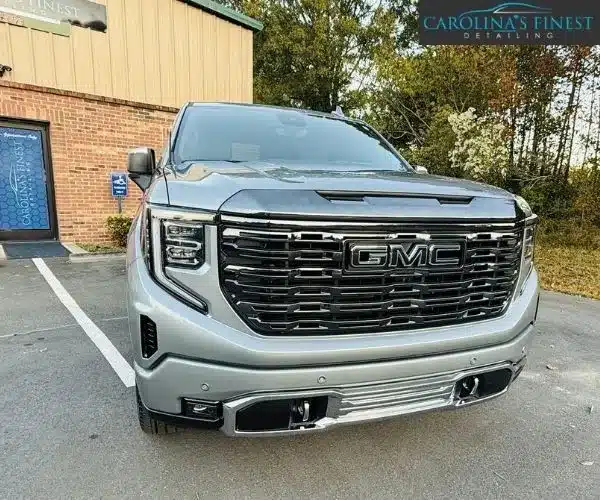
The Carolina’s Finest Detailing Approach to Surface Perfection
Restoring an automotive finish requires disciplined technical execution. At Carolina’s Finest Detailing, our proprietary methodology pairs scientific principles with expert craftsmanship to restore clear coat clarity safely.
Every vehicle undergoes a structured refinement evaluation driven by our commitment to certified excellence. Whether performing a single-stage enhancement or a specialized Weddington paint correction, our technicians assess paint hardness and thickness on an isolated test spot to determine the safest, most effective pad and abrasive pairing.
Our philosophy centers on customer-centric service, providing clear diagnostics and transparent recommendations. We exclusively use professional-grade abrasives and pad systems made from quality materials that contain no fillers or silicones, ensuring your results are permanent rather than temporarily masked.
By combining calibrated dual-action equipment with multi-point paint gauge auditing, we deliver outstanding performance and superior results across every panel. From daily commute vehicles in Weddington, NC to exotic sports cars, our meticulous process protects clear coat integrity while ensuring a seamless and hassle-free car care experience for every client.
The Multi-Stage Refinement Breakdown
Paint correction options vary based on defect depth and paint characteristics:
| Correction Level | Target Defect Removal | Recommended Applications |
| Single-Stage Enhancement | 50% – 70% Defect Removal | Light swirl marks, soft clear coats, and routine gloss restoration. |
| Two-Stage Correction | 85% – 95% Defect Removal | Moderate to deep swirls, light etching, and isolated scratches. |
| Multi-Stage Restoration | 95%+ Defect Removal | Heavy weathering, deep scratches, severe oxidation, or vintage paint. |
Stage 1 (Decontamination): Iron removers dissolve embedded brake dust, and synthetic clay bars lift bonded surface contaminants so abrasives move smoothly over the panel.- Stage 2 (Heavy Cutting): A high-cut pad and compound remove the top peak layer. Vehicle owners seeking paint correction in Weddington rely on this stage to safely level deeper scratch boundaries.
- Stage 3 (Refinement): A fine foam pad and finishing polish eliminate remaining micro-haze, boosting reflection and optical clarity without leaving buffer marks.
Preserving Your Finish Post-Correction
Applying a professional ceramic coating builds a hard silica barrier over the fresh clear coat, adding scratch resistance and UV protection. Maintain these results using safe washing habits:
- Two-Bucket Method: Separate wash shampoo and rinse water using grit guards to keep dirt off your wash mitt.
- Plush Microfiber Drying: Use borderless, high-GSM microfiber towels or forced air blowers to prevent drying scratches.
- Avoid Contact Car Washes: Skip automated brush washes that drag grit across clear coats.
People Also Ask
Does paint correction remove the clear coat permanently?
Yes, it mechanically removes a microscopic fraction of the clear coat. However, a professional only removes 2 to 3 microns, leaving the vast majority of your clear coat intact.
How do I know if a scratch is too deep to polish out?
If your fingernail catches in the scratch, it has penetrated past the clear coat into the base coat or primer. These require touch-up paint or wet sanding rather than standard polishing.
Is paint correction safe for soft or thin paint?
Yes. Technicians use paint depth gauges and select ultra-soft finishing pads with light polishes to safely enhance thin or soft paint finishes.
How often can paint correction be performed?
Heavy multi-stage correction should only be done once or twice in a vehicle’s life. Routine hand-washing and ceramic protection preserve the surface without further thinning the clear coat.
Can paint correction remove water spot etching?
Yes. Polishing levels out both mineral deposits and the shallow clear coat etchings caused by acidic water spots.
Experience the Difference with Carolina’s Finest Detailing
Swirl marks and micro-scratches dull your paint’s natural brilliance over time, but you do not have to accept a hazy finish. At Carolina’s Finest Detailing, we treat every vehicle with precision, care, and an unwavering commitment to perfection.
To restore your vehicle’s gloss and clarity, explore our options for or contact us today to schedule your consultation.